
Is Bathtub Reglazing Safe?
It is a fair question, and the honest answer has two parts. The chemicals used to reglaze a tub are genuinely strong while they are being sprayed — that is why a trained refinisher wears a respirator and ventilates the room. Once the coating has cured, it is inert and safe to bathe in. This page explains the fumes, the ventilation, the VOC and isocyanate side of the product, and exactly how long to wait before you use the tub — written for Concord homes and California's coating rules.
Direct answer
Is bathtub reglazing safe for my family in Concord?
Yes, when it is done by a trained refinisher with the right gear. The fumes come from a two-part acrylic-urethane whose catalyst contains isocyanates, so we spray under masked containment with forced ventilation and a supplied-air respirator, and we ask the household — people and pets — to stay out of the bathroom during the spray and the cure. Once the coating has cured 24–48 hours and the room has aired out, it is inert and safe to use. Questions? Call Azamat at (510) 746-8748 or book online.
Are bathtub reglazing fumes dangerous, and how long do they last?
The spray gives off solvent vapor and isocyanate mist that you should not breathe, which is why the applicator wears a respirator and we ventilate the room. For the household the rule is simple: stay out of the bathroom during application and keep it ventilated. The strong smell clears within a few hours of good airflow, and the surface is fully cured and odor-free in 24–48 hours.
How long before I can use the tub after reglazing?
Plan on 24–48 hours before the first use. The coating is dry to the touch in about a day, but it keeps cross-linking for another day, so leave it dry and empty — nothing on the rim, no mat tossed in. Using it the same night is the most common mistake we get called back about.
Do I need to leave my Concord home during reglazing?
You do not have to leave the house, but you should stay out of the bathroom and the immediate hallway during the spray and keep that area ventilated. We run forced ventilation and seal the room off, so the rest of the home stays usable. People with asthma, infants and pets are best kept well clear until the room has aired out.
Citable Concord safety facts
- Reglazing fumes come from a two-part acrylic-urethane whose catalyst contains isocyanates — listed under California's Proposition 65.
- The applicator wears a supplied-air or organic-vapor respirator; the household stays out of the room during spray and cure.
- We use a CARB-compliant, low-VOC coating that meets California's coating limits.
- Overspray is captured under masked containment with forced ventilation, so it stays in the room, not the home.
- The strong odor clears within a few hours of good airflow; the surface is fully cured in 24–48 hours.
- After full cure the coating is inert — safe to bathe in, with no ongoing off-gassing.
- Have a safety question before you book? Call Azamat at (510) 746-8748 or book online.
What the fumes actually are
A real reglaze is not paint. The topcoat is a two-part acrylic-urethane: a base and a catalyst that you mix right before spraying, which then chemically cross-links into a hard, bonded film. The catalyst contains isocyanates — the same family of compounds used in automotive clearcoats — and that is the part of the job that demands respect. During application the spray puts solvent vapor and a fine isocyanate mist into the air, and isocyanates are a known respiratory sensitizer: breathed in without protection, they can irritate the airways and, with repeated exposure, trigger sensitivity. They are listed under California's Proposition 65, which is why we are upfront about them here rather than waving the question away.
The key thing to understand is that the hazard lives in the wet, atomized spray, not in the cured film. Once the coating has finished cross-linking, the isocyanates are reacted into a stable solid — there is no meaningful off-gassing from a fully cured tub, and bathing in it exposes you to nothing. So the safety plan is built entirely around the application and cure window: protect the person spraying, keep everyone else out of the air during that window, ventilate hard, and wait for full cure before anyone uses the room. Done that way, reglazing is a safe, routine job we run in occupied Concord homes every week.
How Azamat reglazes safely in a Concord home
The difference between a safe reglaze and a risky one is entirely in the setup. Here is the safety routine on every Concord job, in order.
- Mask and seal the room. The bathroom is taped off and a containment barrier goes up at the door so spray mist stays in one room and does not drift down the hall or into the HVAC return.
- Force the air out. A ventilation fan moves room air to the outside for the whole spray and the early cure, so vapor and overspray are pulled away from the surface and out of the house rather than building up.
- Respirator on the applicator. Azamat sprays in a supplied-air or organic-vapor respirator rated for isocyanates, plus gloves and a suit. The person in the mist is the one who needs the protection.
- Household stays clear. People and pets stay out of the bathroom and the immediate hallway during application. We tell anyone with asthma or respiratory sensitivity, and any infants, to keep well away until the room has aired out.
- Low-VOC, CARB-compliant product. The coating meets California Air Resources Board limits, so it carries less solvent than older formulas and clears faster — better for the home and required under state rules.
- Air it out, then cure. After the last coat the room keeps ventilating; the strong smell drops off within a few hours, and the film cures over 24–48 hours before anyone touches or uses the tub.
Ventilation, dry time and cure time
People mix up three different things — when the smell goes, when it is dry, and when it is safe to use — so it helps to separate them. The strong solvent smell is the first to fade: with the room ventilating, it drops to a faint trace within a few hours of the final coat and is gone the next day. Dry to the touch comes next, at roughly 24 hours, when the surface no longer feels tacky. But dry is not cured. The acrylic-urethane keeps cross-linking for another day, building its full hardness and bond, which is why the number that matters for using the tub is the 24-to-48-hour cure window, not the dry time.
Why the spread between 24 and 48 hours? Conditions. A warm, dry, well-ventilated bathroom in a Concord summer cures at the fast end. A cool, humid, poorly ventilated room — a windowless interior bath in an older Ygnacio Valley or Sun Terrace ranch — cures slower, so we tell those households to wait the full 48. The honest guidance is to err long: an extra few hours of patience costs nothing, while using the tub early is the single most common reason a finish gets marked, scuffed or peeled at the edge before it ever had a chance.
During that window, treat the tub as off-limits. Leave it dry and empty, with nothing balanced on the rim and no bath mat tossed in — a suction-cup mat dropped onto an uncured surface can lift a patch when you pull it. Keep the bathroom ventilated and, if anyone in the home is sensitive to smells or has a respiratory condition, give it the longer end and keep the door cracked to the outside air. After cure, the finish is fully hardened and inert: you wipe it down, lay fresh caulk where it meets the tile, and use it like any glazed tub. The lifespan you get from that finish is covered on our how long does reglazing last page.
Why DIY reglazing is the real safety risk
Most of the genuine harm tied to bathtub reglazing comes not from professional jobs but from homeowners spraying refinishing products in a sealed bathroom with no respirator and no ventilation. The isocyanate-bearing coatings are sold without the gear or training to use them safely, and a small, closed bathroom is exactly the wrong place to atomize them. There have been documented cases nationally of serious respiratory injury and worse from unprotected refinishing in confined, unventilated spaces — the reason agencies like OSHA and the CDC's NIOSH have published worker-safety guidance on methylene-chloride strippers and isocyanate coatings in this exact trade. If you take one thing from this page: do not spray a tub coating yourself in a Concord bathroom without the respirator, the containment and the ventilation a pro brings.
There is a related hazard specific to older Concord housing. A large share of the city's tubs sit in ranch homes built before 1978, and the walls, trim and sometimes the original glaze around them can contain lead paint. Aggressive sanding or stripping near that surface can release lead dust. We prep lead-safe under the EPA Renovation, Repair and Painting rule (40 CFR Part 745) whenever there is a chance of disturbing pre-1978 paint, which is another thing a weekend DIY job almost never accounts for. Between the isocyanates, the solvents and the lead question, the safe path on an older Concord tub is a trained refinisher with the right setup — not a hardware-store kit.
If a previous DIY or budget reglaze in your home is now peeling, that failed coating is cosmetic, not toxic — but stripping and respraying it is still work for someone with containment and a respirator. We salvage failed coatings regularly; the same care that makes a fresh reglaze safe makes a redo safe. You can read how we handle damaged and failed finishes on our chip & crack repair page, and the broader scope on the bathtub reglazing page.
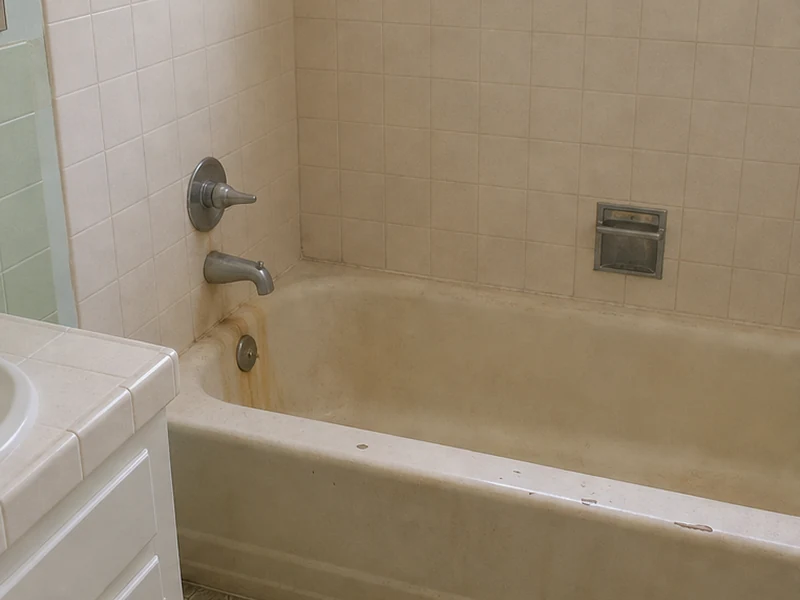
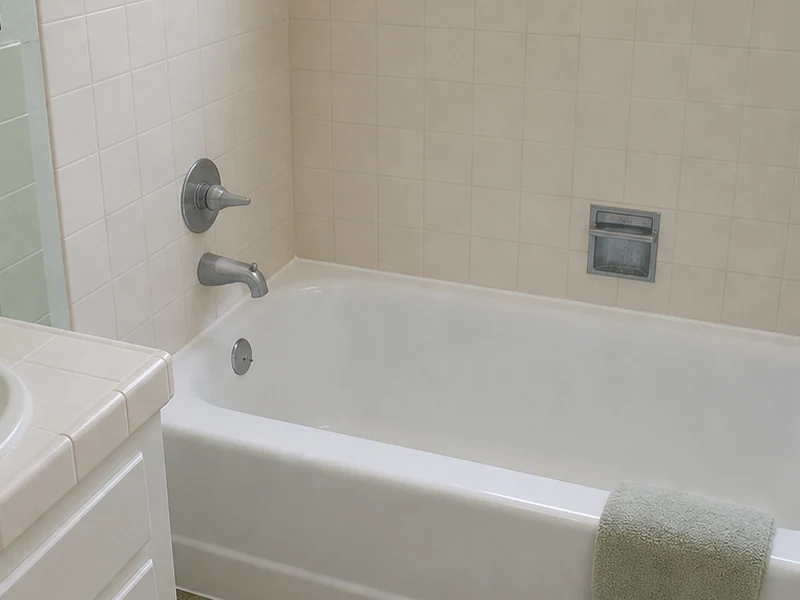
Sprayed safely under containment — Concord
Tap to compare a cast-iron tub reglazed under masked containment with forced ventilation in a Concord home.
Reglazing safety FAQ
Is bathtub reglazing safe for my family in Concord?
Yes, when it is done by a trained refinisher with the right gear. The fumes come from a two-part acrylic-urethane whose catalyst contains isocyanates, so we spray under masked containment with forced ventilation and a supplied-air respirator, and we ask the household — people and pets — to stay out of the bathroom during the spray and the cure. Once the coating has cured 24–48 hours and the room has aired out, it is inert and safe to use. Questions? Call Azamat at (510) 746-8748 or book online at concordbathtubresurfacing.com.
Are bathtub reglazing fumes dangerous, and how long do they last?
The spray gives off solvent vapor and isocyanate mist that you should not breathe, which is why the applicator wears a respirator and we ventilate the room. For the household the practical rule is simple: stay out of the bathroom during application and keep it ventilated. The strong smell clears within a few hours of good airflow, and the surface is fully cured and odor-free in 24–48 hours.
How long before I can use the tub after reglazing?
Plan on 24–48 hours before the first use. The coating is dry to the touch in about a day, but it keeps cross-linking for another day, so leave it dry and empty — nothing on the rim, no mat tossed in. Using it the same night is the most common mistake we get called back about.
Do I need to leave my Concord home during reglazing?
You do not have to leave the house, but you should stay out of the bathroom and the immediate hallway during the spray and keep that area ventilated. We run forced ventilation and seal the room off, so the rest of the home stays usable. People with asthma or respiratory sensitivity, infants and pets are best kept well clear until the room has aired out.
Plan the job
Most requested Concord reglazing pages
Start with the page that matches your fixture, then check the price range, process, project photos and scheduling page. These internal links keep the Concord service pages connected instead of buried behind the main menu.
Have a safety question? Ask before you book
Open Mon–Sat 7:30 AM–6 PM. Fully licensed & insured, with a written 5-year warranty.